
The Making of
The Legend
In the quiet suburb of Maison-Alfort, Fragonard lived surrounded by his strange work—cadavers, dissections, and anatomical experiments. Yet in the midst of this grim life, he fell in love. The object of his affection was the daughter of a local grocer, a young woman full of life and warmth. Their love was strong, but her parents were horrified. To them, Fragonard was a man who cut into the dead, a profession too frightening, too shameful, for their daughter to be tied to.
They forbade the marriage, and under the weight of sorrow the girl grew weaker each day until grief consumed her. She died still in love, and still forbidden.
This is where the story turns to legend. It is said that, unable to let her go, Fragonard returned to her grave at night, exhumed her body, and transformed her into his most famous and haunting work—*The Rider of the Apocalypse*. Instead of losing her, he gave her a new, eternal body, one that would ride forever between death and immortality.
The Fragonard Affair
The Key
The project began with a rumor.
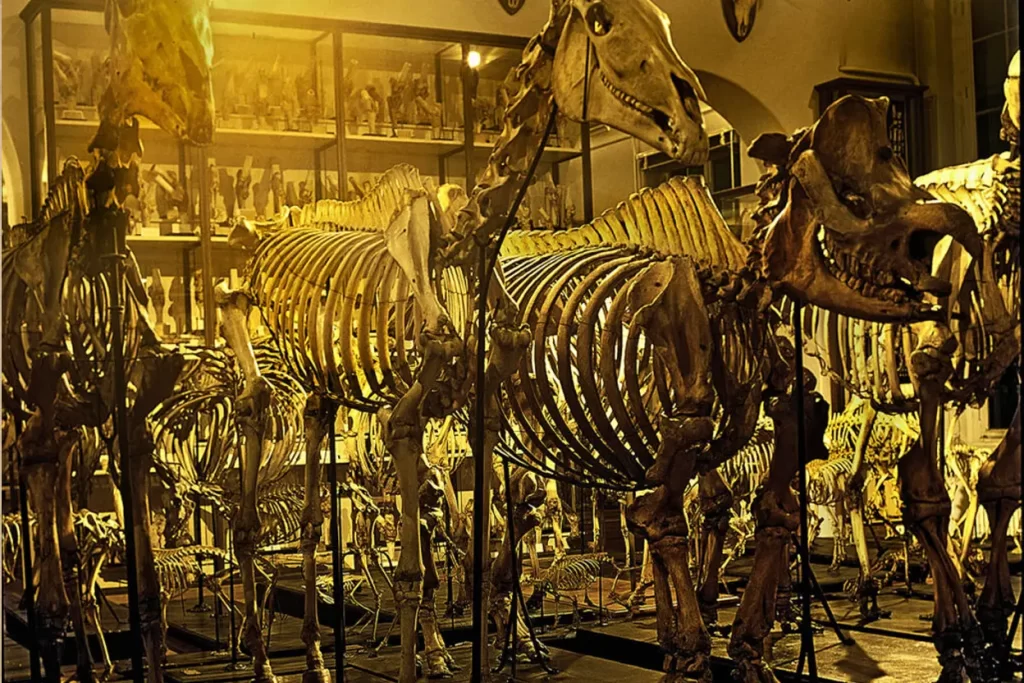
A friend told me about a hidden room inside the Veterinary Museum of Maisons-Alfort containing the legendary Fragonard specimens—human and animal cadavers transformed into anatomical sculptures more than two centuries earlier. The collection was rarely seen and almost never photographed.
I immediately wanted to document it. The museum refused my request. The specimens were too fragile, too valuable, and too difficult to preserve. Officially, the project was impossible.
Instead of giving up, I became obsessed. Over the following months, I spent time around the museum, spoke with employees, and learned everything I could about the collection. Then, through a series of fortunate circumstances, I found myself holding the key to what staff members called the Horror Room.
The moment that key landed in my hand, the project crossed a line.
Together with a friend, I began entering the museum after hours. Night after night, while the city slept, we carried cameras and lighting equipment through silent corridors and worked among some of the most extraordinary anatomical creations ever made. If we were caught, the project would be over.
If we damaged anything, the consequences would be far worse. Neither possibility was enough to stop us.
The Dead Fight Back
Access was only the first challenge.
The real problem appeared when we turned on the lights.
Years of protective varnish had left the specimens covered with highly reflective surfaces. Every flash transformed muscles, veins, and tendons into a mass of glare. The photographs were unusable.
We experimented for days, knowing that every additional night inside the museum increased the risk of discovery. Eventually we developed a solution using polarizing filters mounted on both the camera and the lights. The reflections disappeared, but so did most of our illumination.
We lost nearly ninety percent of our light.
The work became painfully slow, requiring long exposures and endless adjustments. Yet little by little the collection revealed itself. Each successful photograph encouraged us to continue.
Only one subject remained.
The Horse
The mounted horseman was the masterpiece of the collection and the one image we could not obtain.
Protected behind glass, it reflected light from every direction. No technique worked.
Finally we made a decision that sounds reckless even today.
We removed it from the display case.
Late at night, we carefully carried the horse and rider into a corridor where we could photograph them without reflections. The specimen was priceless. Every movement felt dangerous.
Once it was in position, another problem appeared. The horse was too large for our lighting equipment. We solved it by photographing in complete darkness and painting the figure with a spotlight during long exposures.
The process took the entire night.
By dawn we had the image.
Exhausted, we packed our equipment and left. The corridor was a mess. Film boxes, food containers, cables, and equipment were scattered everywhere. Worse still, the horse and rider remained in the middle of the hallway.
We should have put everything back.
Instead, we convinced ourselves that nobody would enter the room before our return.
We were wrong.
The Arrest
The next morning, the museum director happened to be hosting an important Japanese museum official. Proud of the Fragonard collection, he decided to show his guest the hidden treasures of the museum.
When he opened the door, he found the horse standing in the middle of the corridor surrounded by the remains of our all-night photographic operation.
The reaction was immediate.
An investigation was launched, and by the time my friend and I returned that evening, the police were waiting.
I was escorted to the director’s office and questioned about how we had gained access and what we thought we were doing. Then I remembered something.
One photograph was still missing.
While the director and the police focused on me, I quietly told my friend to go back and finish the job.
For the next hour, I answered every question as slowly as possible, buying him time.
Eventually he returned.
He didn’t need to say a word.
The last photograph had been taken.
We had been caught.
But we had completed the project.
From Arrest to Book
When the museum director caught us, I assumed the adventure was over. Instead, it was only entering a new phase. As the anger subsided, the photographs began to speak for themselves. What had started as an unauthorized project gradually evolved into a collaboration with the museum. The director eventually agreed to support the publication and even wrote the introduction. The photographs survived, the book was published, and the Fragonard collection reached an audience far beyond the walls of Maisons-Alfort.