
A Few Words About
The Other Fragonard
The Anatomist Who Turned Death Into Art
Honoré Fragonard was not the polite kind of scientist you imagine in a clean white coat. He was something stranger.
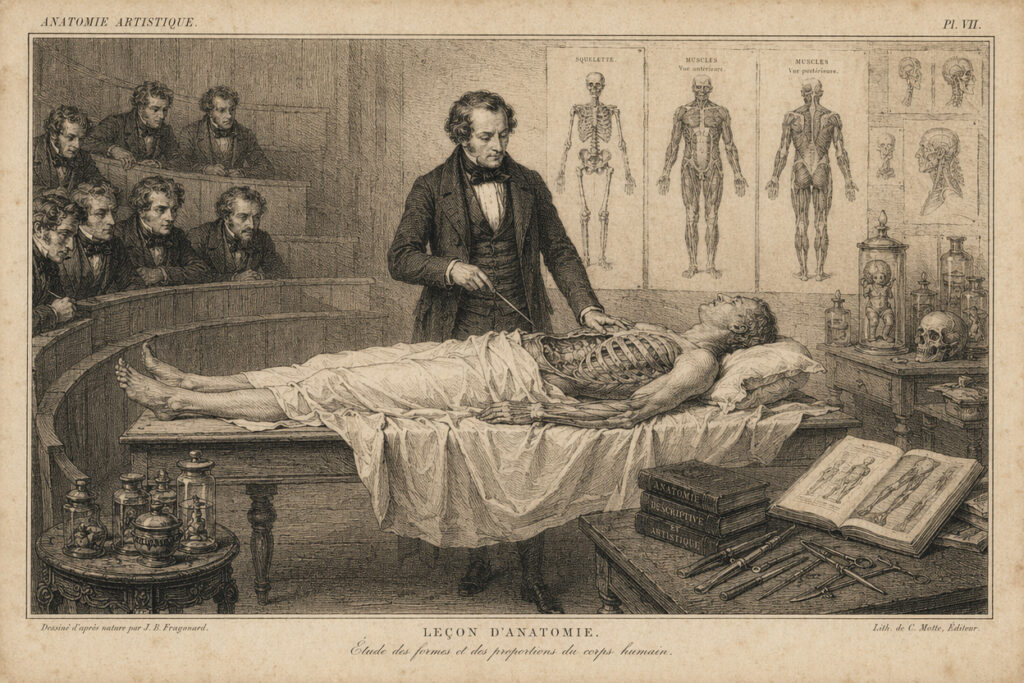
He was born in Grasse (France) in 1732, and at first his life looked respectable enough. He became a surgeon, then an anatomy teacher. But Fragonard was not satisfied with books, drawings, or lectures. He wanted to go deeper — literally under the skin.
At the veterinary school of Maison Alfort, near Paris, he began making anatomical preparations unlike anything people had seen before. He removed the skin from bodies, exposed the muscles, nerves, and veins, and then preserved them with a secret technique. But he didn’t just prepare them for study. He posed them. For the school, he was too weird.
After he was thrown out of Maison Alfort, Fragonard did not stop. He simply moved his strange genius elsewhere. He began creating anatomical pieces for wealthy private collectors, for aristocrats and curious members of high society who wanted something shocking, rare, and impossible to find in an ordinary salon. To own a Fragonard was to own a secret — a sculpture made of death, science, and forbidden beauty. But when the French Revolution came, that taste for strange luxury became dangerous. Many of these works vanished, dispersed or destroyed, swept away with the world that had paid for them. What survived is only a fragment of the nightmare he once created.
Nobody knows where he got the bodies from, he did not leave any info on his practice…
That is where Fragonard becomes fascinating — and unsettling.
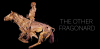
His figures were not lying quietly like medical specimens. They looked alive, dramatic, almost possessed. A rider on a horse. A man standing like a hero. A body transformed into a strange sculpture of muscles and movement. It was anatomy, yes, but it was also theater. Science mixed with obsession. Beauty mixed with horror.
People didn’t know what to do with him. Was he a genius? A madman? An artist? A scientist? Maybe all of those things at once.
Fragonard wanted to serve science, but he was too strange for the scientific world. His work was too intense, too personal, too disturbing. Eventually, he was pushed aside, and after his death in 1799, most of his creations disappeared.
Only a few survived.
Today, when you see them, you understand immediately: this was not an ordinary man. Fragonard looked at the body as if it were a secret machine, a battlefield, a miracle, and a nightmare.
He was the other Fragonard — the weird one, the forgotten one, the one who turned anatomy into something impossible to forget.
Alain Bali Biography
Alain Bali is a French-born photographer and visual artist based in Los Angeles. His relationship with photography began at a young age, when he first discovered the magic of the camera through his father’s Kodak Retina. What started as childhood fascination became a lifelong obsession with images, memory, beauty, and the strange poetry of real life.
Bali began his career in Paris, working in photojournalism and contributing to major French publications including Paris Match and Vogue. His camera led him through different worlds — from the underground music scene of Paris to the streets of Beirut, Tokyo, and Los Angeles. His work often captures the tension between glamour and decay, elegance and chaos, intimacy and danger.
Over the years, Alain Bali has developed a visual language that is both raw and cinematic. His photographs are not simply documents; they feel like fragments of stories, suspended between reality and dream. Whether photographing punk culture, urban landscapes, portraits, or scenes of destruction and desire, his work carries a strong emotional charge and a sense of mystery.
His photographs have been exhibited in galleries and cultural venues including Galerie Agathe Gaillard, Galerie du Jour, Galerie Agnès B in Hong Kong, Rencontres Internationales d’Arles, Cité de la Musique, and Espace Art 22.
Today, Bali continues to create work that explores the power of the image — its ability to seduce, disturb, remember, and reveal what words cannot fully express.